My morning drive is usually a familiar kind of boredom.
I wake up just early enough to resent it, slide into the car, and resume my long-term relationship with capitalism. I open my navigation app like I don’t already know the way to a place I’ve been going to every day for the last two years, choose a Spotify playlist to set the mood, and begin the pilgrimage.
Work awaits: cafeteria food waste posters, new names for a colorful cocktail, and a fifth revision of a deck that refuses to be finished, depending on who you ask.
Eventually I reach CAVITEX. Nothing happens. Nothing should happen. The most suspense I get is the will-they-won’t-they of merging into the rightmost lane before the expressway ends, so I can climb NAIAX—an act that feels, on good days, like being God’s favorite.
I signal because I am polite. I inch forward bit by bit. I negotiate with strangers using nothing but blinkers and hope. I ask for charity, and they give it—sometimes freely, sometimes as a favor they’ll keep count of.
That is the entire plot.
Not that day.
I was, according to Waze, 400 meters from my parking space entrance. Nothing should happen. The enforcer had already raised his hand, holding the lane still so we could pass. As I turned left—obedient, almost virtuous—a bicycle appeared. He did not look. He did not slow down. He arrived the way a clever comeback does: fast, out of the blue, and already too late.
And then he hit me.
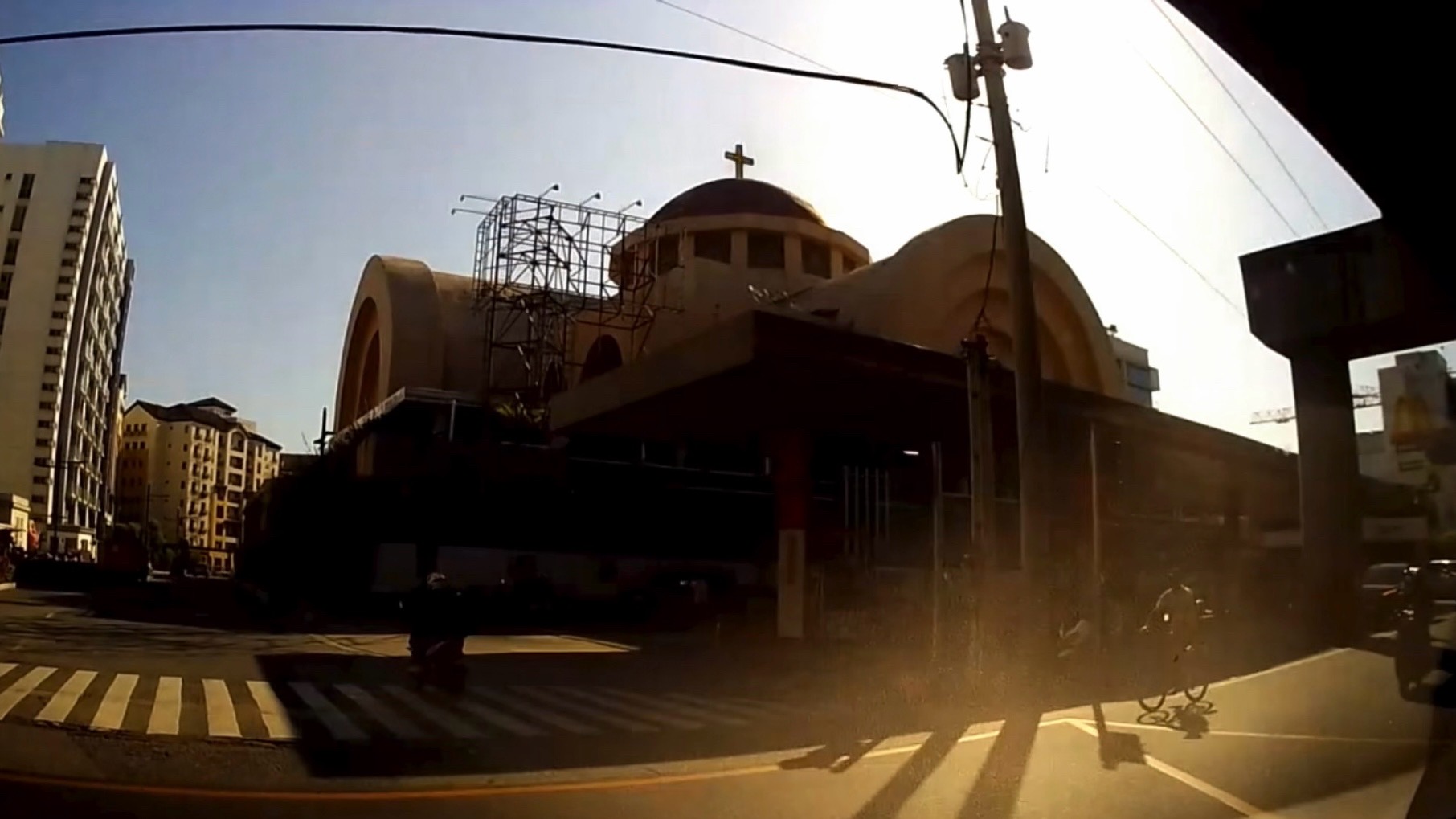
Or, depending on whose version—
I hit him.
Or we hit each other.
There is a version of this story where I panic, where I tremble, where I become the kind of hysterical person telenovelas has trained me to be in moments like this. But what surprised me more than the impact was how calm I was.
Calm as the Newport City ambulance arrived, efficient and unfazed.
Calm as they lifted the man, noting his knees.
Calm, until I walked back to the car to get my papers and—because the body must release something—shouted to my uncaffeinated self:
Putangina!
Then calm again.
Calm as the questions arrived from the tiny part of my brain that anticipates consequences:
What if something is broken? What if there’s more injury inside?
What if I go to jail?
Up close, the man was quieter than the situation required. He tried to sit up inside the ambulance and immediately faltered. His leg refused him, his face dangerously close to tears as the EMT scolded him with a kind of kindness.
“Patawagan naman po sa asawa ko,” he said, looking at me. Not demanding. Not even angry.
I dialed the number, and when he spoke to her, his voice changed. Like this was just a small delay he had to report.
A coworker saw the accident and pulled over. For a brief, impulsive moment, I leaned into his shoulder.
I was calm, but it was nice not to be alone in it.
*****
Pasay General Hospital looks less like a hospital and more like a rough draft of one. Patients spill into the lobby. Nurses inject drugs in plain sight. You see people getting oxygen like a private intrusion.
You look around and think—not even angrily, but with a kind of sociological sadness: Is this where our taxes go? It’s a punchline no one laughs at anymore.
Perhaps surprisingly, the doctors that attended to the man were Indian interns. They were focused and professional in a quiet way. I had no issue, but the police officer who escorted us could not resist commentary.
“Puro alien ang nandito. Sa susunod, pati guard, alien na.”
I brushed it aside. Arguing with casual racism would not improve the day, only lengthen it.
The man’s wife finally arrived and took hold of the wheelchair he was in. The wheelchair seemed to have its own political stance, veering unpredictably left or right. Never center. She pushed him with determination—into the tiny elevator, along the second-floor hallway, into the radiology department.
The X-ray room had no doors. You could, if you wanted, stand at the doorway and absorb a little radiation as a souvenir. Democratic, in a way. You get radiation, you get radiation, everyone gets radiation.
Then, the man had to get a tetanus booster shot. I was given slips of paper to present—one for the supplies center for a syringe, one for the pharmacy for the vial, one for the cashier. It was my own small stations of the cross.
After pacing the hospital floors, there was a little more waiting. Such is the cold roleplay of public healthcare. Within it, time at the emergency room is a drugged version of itself, slow and compliant. And then, almost generously, not even an hour later: the result.
No fracture.
I exhaled like I had been holding my breath underwater for hours.
The relief was immediate, and a little indecent. It moved through me first, fast and private, before I remembered it should probably belong to him.
The knee, nabugbog—a word more honest than any clinical term. Swollen, shocked, offended, but expected to be manageable with a healthy dose of celecoxib.
I agreed to pay the bill. The woman at the counter asked if the patient had a senior citizen ID. He did not. It was still being processed—the way all important things in this country seem permanently in the process of waiting.
I contained my explosion.
“Hindi kailangan ng senior citizen ID para sa discount. Kahit anong government ID, okay na basta may birthday.”
She gave me a stern look.
“‘Yun po ang policy. Hinahanap po ‘yan sa record.”
I said, “Hindi. Labag ’yan sa batas.”
It was a threat that didn’t sound like a threat, and yet landed as one.
They accepted it. No apology. No acknowledgment. Just a silent pivot, without admitting they were wrong.
After the hospital shenanigans, we had to proceed to the Pasay Traffic Bureau, where bureaucracy takes over from biology.
We crammed ourselves into the backseat of the police vehicle—the man, his wife, and me—no one speaking, as the officer backed out of his parking slot. A bicycle zoomed past behind us, refusing to give way. He rolled down the window and shouted, “Ang kukulit! Ipipilit talaga!”
I laughed, louder than necessary, hoping everyone in the car would hear the irony.
Somewhere, an old man turned 98.
*****
If you ever had to find the city’s traffic bureau, it would look like this: part-office, part-sidewalk—a desk and plastic chairs set out where the afternoon sun can reach you, impounded motorcycles lined up for red tape. Inside, a man sat behind the cells, his head hanging low, as if asking forgiveness from the dirty concrete floor. I learned, in passing, that there had been a death. Lucky it wasn’t me.
At the station, forms were filled. Statements were made. The goal, we were told, was to end this in an amicable settlement, which is police-speak for without anyone having the energy to fight. And somewhere in the middle of all this, a thought kept returning, stubborn as Manila traffic:
In this hellhole of a city, the most vulnerable move as if they were the most invincible.
Bicycles weave. Motorcycles slice through lanes with a faith that would put Nazareno devotees to shame. They forget—or perhaps don’t care—that human bodies are soft, squishy things.
Kamote juice, anyone?
Every day in the streets of Metro Manila is chaotic choreography. You think you are careful. You think you are safe.
You are neither.
You are simply next.
My victim—no, that’s legally unwise—my fateful friend turned out to be a cook for the Philippine Navy. A man with a chopping board routine, a life that depends on the quiet continuity of days that do not include strangers hitting you with cars.
There is a point where justice becomes less important than ending the scene.
He was, by most accounts, at fault. But fault is a luxury: useful in theory, exhausting in practice.
We settled. No one wanted this to happen. Everyone, including the blindfolded lady, was tired.
His daily wage for every day he cannot work. Two weeks maximum, the doctor said. I did not argue. Again, I had neither the energy nor the caffeine in my system.
The follow-up checkup, I decided, would be his. Let him deal with that.
By the end, the man was resigned, letting his wife do the talking and the writing. I imagine that’s what wives do when they know their husband is at fault: they manage the aftermath, preserve what face can still be saved.
I handed her the money, paying for a sin I wasn’t sure I had committed.
There was a small, nagging thought that I might have been outsmarted. He never showed a payslip. The amount just appeared, and I agreed to it the way I agree to things when my baby nephew insists the blue is actually green. Later, I realized I had also paid for Maundy Thursday and Good Friday. But by then, it was done.
Christ died, and I covered the bill too.
When we left, the wife was still trying to find a taxi willing to take both the couple and the bicycle home—which, by some mercy of God, wasn’t damaged. The city is challenging for the injured. It is challenging for everyone, really, unless you are already insulated from it.
And here is where I look for meaning to this ordeal, whether I want it or not.
Two men collide, but only one of them can afford for it to be an inconvenience. Don’t get me wrong: it was a substantial amount of money for me too. But for the other, it is an interruption of income, of survival, of the thin thread that holds a household together.
The accident was an accident, but in a way, it is not.
Because the roads themselves are designed not just for movement, but for hierarchy: who gets lanes, who gets protection, who gets to be forgiven. Even the hospital participates. Even the paperwork. We are all moving through systems that decide in advance how much our pain is worth.
And somewhere beneath all this, I could feel a harder truth I wasn’t proud of:
that I blamed him.
Not completely, not cleanly. But enough.
Enough to imagine an alternate version of the day—that if he had slowed down at the intersection, I would be at my desk, staring at a Google Document, coming up with casino promo names instead of this essay.
Enough to wish, fully aware of how selfish that was, that it had been someone else’s car.
Enough to believe, in some quiet corner of myself, that this had happened to me—
That I was the injured one.
That is the part I have to sit with: the human way sympathy and blame can occupy the same space, taking turns, never quite canceling each other out.
We are, after all, soft, squishy, complicated things.
*****
By the time I got back in my car, the day had resumed its usual rhythm: traffic, heat, the long, indifferent road leading me home to the bed I deserve.
Exiting CAVITEX southbound, I merge into the rightmost lane.
And suddenly—a man on a bicycle, ready to cross without looking twice.
I honk, five seconds longer than necessary.
Putangina.
It never ends.
 Schmuckumentary
Leave a comment